

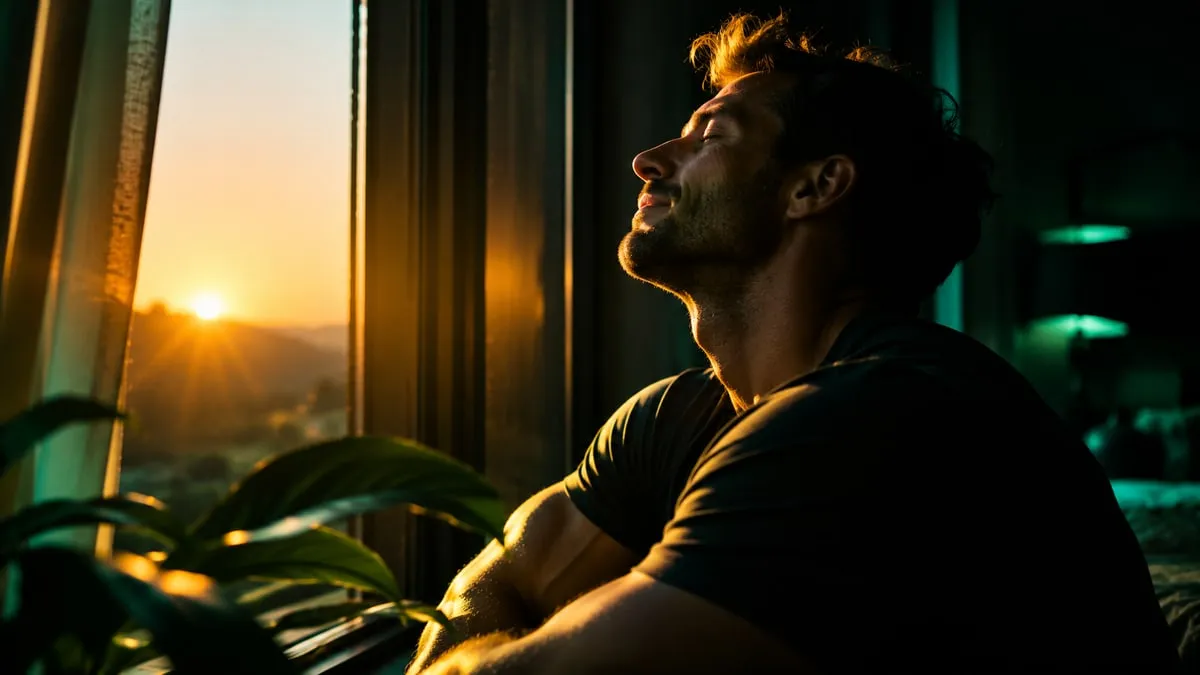
Morning light and your body clock: the cheapest biohack
Biohacking often means expensive gadgets and complicated rules, yet one of the best “hacks” is free: morning light. Your body’s internal clock aligns with natural light, and this can affect your sleep, your energy and your mood.
Our body clock’s roughly 24-hour rhythm is set mainly by light. In a camping study, participants who went back to natural light shifted their rhythm to sunrise, and their melatonin production started earlier.
What this means in practice
- Go outside for 10–30 minutes in the morning, even when it is cloudy: outdoor light is many times brighter than indoor light.
- Dim the lights in the evening, and put your screen away an hour or two before bed.
- Wake up at a similar time every day, weekends included.
Morning and evening light together
Morning light is only half of the story. In the evening, artificial light and screens can delay falling asleep; you can read more in the article on screens and blue light. The timing of caffeine is also part of how your body clock and sleep work together: see caffeine and sleep.
What not to expect
It is not a miracle cure but a foundation: if you sleep badly, try this first. You probably will not feel a dramatic change within a day or two; the effect builds up over weeks.
How does it connect to training?
Good sleep is the basis of recovering from training. When your body clock is in order, falling asleep and waking up are easier, and that affects your progress too. We write about the role of sleep in detail in sleep and muscle growth.
This article is general information. If you have lasting sleep problems, see your doctor.
Sources
- Blume C, Garbazza C, Spitschan M (2019): Effects of light on human circadian rhythms, sleep and mood. Somnologie 23:147–156
- Wright KP et al. (2013): Entrainment of the human circadian clock to the natural light-dark cycle. Current Biology 23(16):1554–1558
Updated: November 2026
Read on
Sleep and muscle growth: why the night matters
How much sleep you need, what happens to your muscles while you sleep, and what you can do to sleep better alongside training.
Sleep and recovery
Screens in the evening: does blue light matter?
What research says about using screens before bed, and what is worth changing.
Sleep and recovery
Caffeine and sleep: when should you have your last coffee?
How much caffeine is safe according to EFSA, and why it is worth stopping six hours before bed.
Napra: training, meals and weight in one place
Follow your goals with the Napra app: a training log that knows your machines and a meal log.