

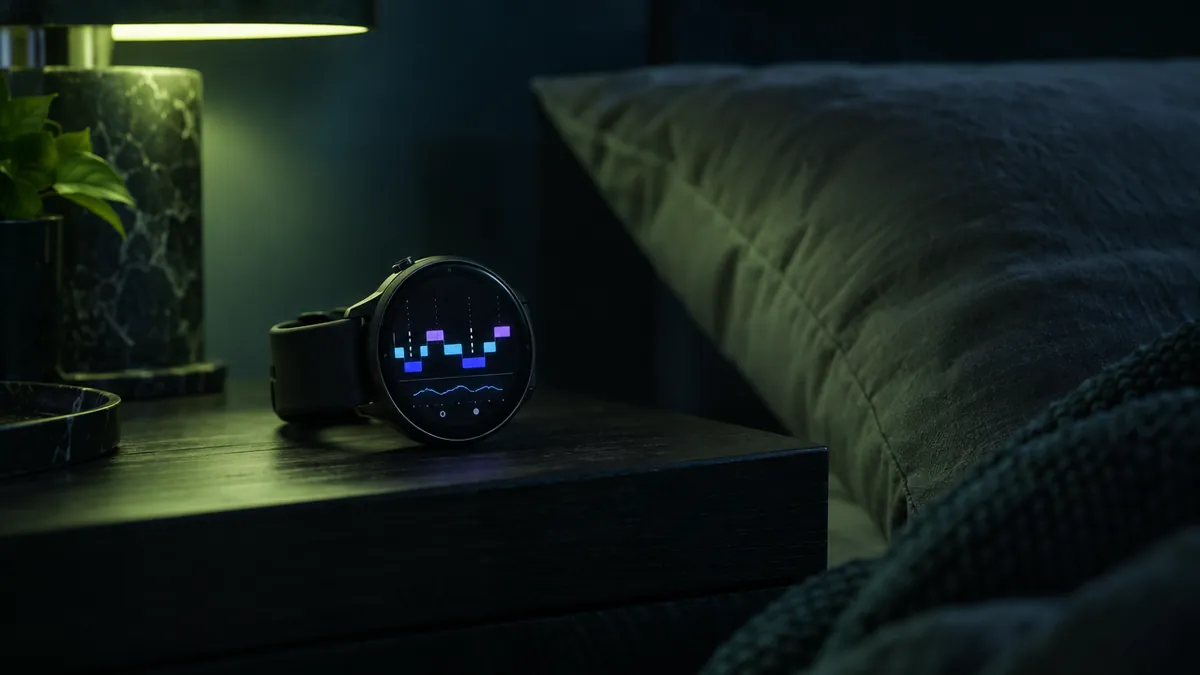
Sleep cycles and deep sleep: what your sleep tracker shows, and what it does not
Sleep is not one steady state: it runs in cycles, about 4–6 a night, each lasting around 90 minutes on average.
The stages of sleep
- Light sleep (N1, N2): about half of your sleep, the transition and part of restful sleep.
- Deep sleep (N3): important for physical recovery and the release of growth hormone. Mostly in the first half of the night.
- REM sleep: the time of dreaming, important for learning and processing emotions. It gets longer in the second half of the night.
How accurate are sleep trackers?
One comparison study tested seven consumer sleep trackers against a lab sleep study (polysomnography). They estimated sleep length and the times of falling asleep and waking fairly well, but their accuracy for sleep stages was poor to moderate.
So use them to follow trends (when you go to bed, how long you sleep), and do not focus on deep sleep minutes or a “score”.
What supports good sleep?
- Regular bed and wake times.
- A dark, cool room.
- Less coffee and alcohol: caffeine, alcohol.
- Fewer screens in the evening.
- Movement and daylight during the day.
More detail: sleep hygiene. How sleep and muscle growth are linked: sleep and muscle growth.
This article is general information, not medical advice.
Sources
- Chinoy ED et al. (2021): Performance of seven consumer sleep-tracking devices compared with polysomnography. Sleep 44(5):zsaa291
- Ohayon M et al. (2017): National Sleep Foundation's sleep quality recommendations: first report. Sleep Health 3(1):6–19
- Walker MP (2009): The role of sleep in cognition and emotion. Ann N Y Acad Sci 1156:168–197
Updated: November 2026
Read on

Sleep hygiene: 10 simple habits for better sleep
How much should you sleep, and how can you improve sleep quality? Practical habits backed by research.
Sleep and recovery
Sleep and muscle growth: why the night matters
How much sleep you need, what happens to your muscles while you sleep, and what you can do to sleep better alongside training.
Biohacking
HRV: what heart rate variability shows, and how to use it
Almost every smartwatch shows HRV (heart rate variability). What does it mean, how accurate is it, and how can you use it wisely for training?
Napra: training, meals and weight in one place
Follow your goals with the Napra app: a training log that knows your machines and a meal log.