

HRV: what heart rate variability shows, and how to use it
Heart rate variability (HRV) shows how much the time between two consecutive heartbeats varies. Paradoxically, more variability usually points to better adaptability: in a calmer state, the heart responds more flexibly.
What does it depend on?
- Age (it declines over the years), genetics, fitness.
- Sleep, alcohol, stress, illness, late meals.
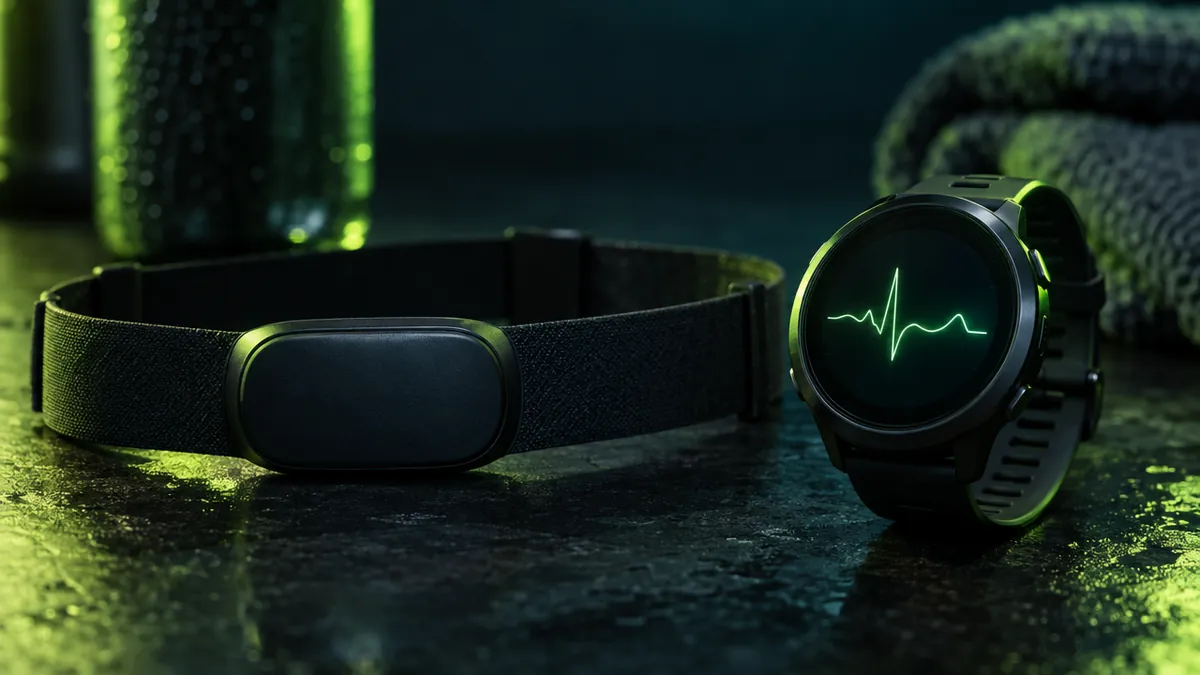
- How it is measured: a morning resting measurement or a night-time average, a watch or a chest strap.
How to use it
- Measure under similar conditions (for example in the morning, after waking).
- Look at the average, not a single day’s number.
- If it stays clearly below your average for several days, and you are also sleeping badly or feeling tired, ease off training or add an easier week.
- If you feel good but the number is low, do not worry. How you feel matters at least as much.
What it cannot do
- It does not diagnose disease.
- The accuracy of smartwatches and chest straps differs, and optical wrist measurement is less reliable during movement.
- There is no proof that “optimising” HRV leads to a longer life.
This article is general information, not medical advice.
Sources
- Plews DJ et al. (2013): Training adaptation and heart rate variability in elite endurance athletes: opening the door to effective monitoring. Sports Med 43:773–781
- Task Force of the European Society of Cardiology and NASPE (1996): Heart rate variability: standards of measurement, physiological interpretation, and clinical use. Circulation 93:1043–1065
- Laborde S et al. (2017): Heart rate variability and cardiac vagal tone in psychophysiological research. Front Psychol 8:213
Updated: November 2026
Read on
Sleep and recovery

Sleep and muscle growth: why the night matters
How much sleep you need, what happens to your muscles while you sleep, and what you can do to sleep better alongside training.
Training
Deload: when and how to take an easier week
A deload is a planned, lighter training week. When do you need one, what does it look like, and when is it unnecessary?
Lifestyle
Stress and exercise: what can training do for tension?
How regular exercise relates to stress, mood and sleep, and how to use it as an everyday tool.
Napra: training, meals and weight in one place
Follow your goals with the Napra app: a training log that knows your machines and a meal log.