

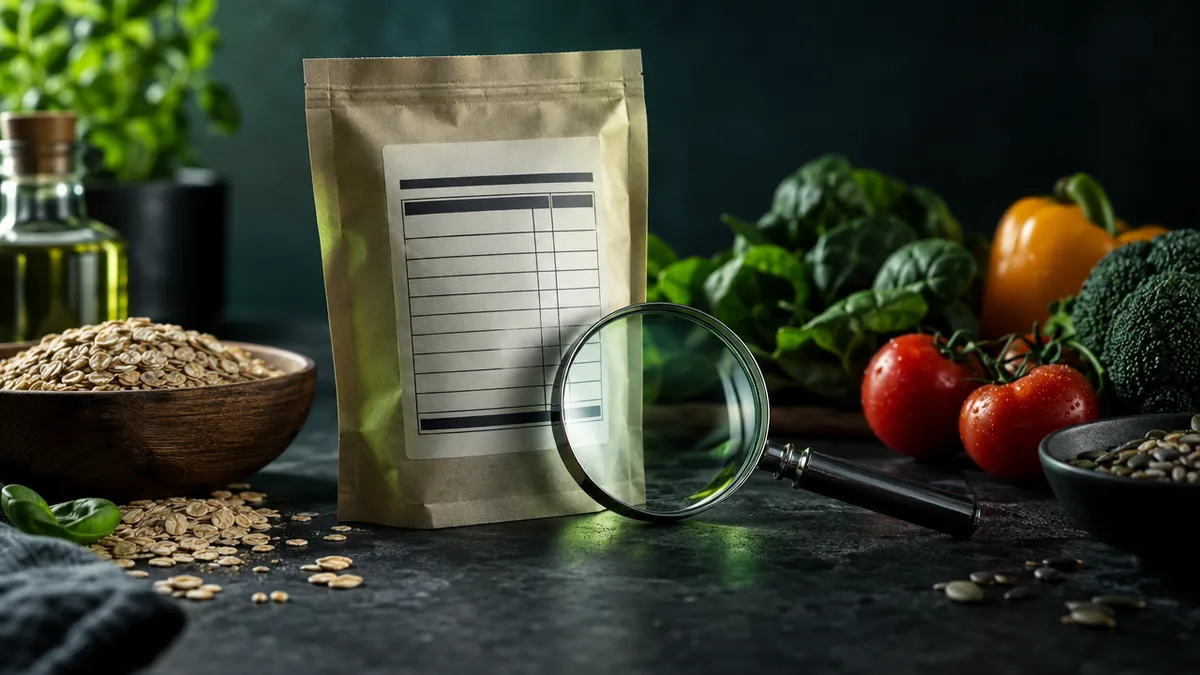
Reading food labels: 6 things worth checking
In the EU, packaged foods must show nutrition information and a list of ingredients. This quick guide shows you what to look for.
1. Serving size: 100 g or a portion?
The mandatory table refers to 100 g (or 100 ml). Many brands also give values “per portion”, but that portion may be smaller than what you actually eat. Convert it to your own portion.
2. Energy and macros
Look at energy (kcal), protein, carbohydrates (of which sugars) and fat (of which saturates). Track calories and protein: how many calories should I eat.
3. Sugar
“Of which sugars” includes both natural sugars (such as milk sugar and fruit sugar) and added sugar. Added sugar shows up in the ingredients (sugar, glucose syrup, fructose and so on). See: added sugar.
4. Salt
Salt is given in grams. Above 1.5 g per 100 g counts as “high”, below 0.3 g as “low”. More detail: salt and blood pressure.
5. The ingredient list
Ingredients are listed in descending order by amount, so the first 3 make up most of the product. A long list with many additives often signals an ultra-processed product: ultra-processed foods.
6. Claims on the package
Claims like “high protein” (at least 20% of energy from protein), “sugar-free” (max. 0.5 g per 100 g) or “light” (at least 30% less of something) are regulated, but they do not mean the product is healthy: a “protein bar” can still have a lot of sugar and fat.
This article is general information, not medical or dietary advice.
Sources
- Regulation (EU) No 1169/2011 of the European Parliament and of the Council on the provision of food information to consumers
- Regulation (EC) No 1924/2006 of the European Parliament and of the Council on nutrition and health claims made on foods
- Campos S et al. (2011): Nutrition labels on pre-packaged foods: a systematic review. Public Health Nutr 14(8):1496–1506
Updated: November 2026
Read on
Ultra-processed foods: are they really harmful, and what does it mean day to day?
Ultra-processed foods under the NOVA classification and health: what research shows, and how to sensibly cut down on them.
Nutrition
How much sugar is too much? Added sugar and sweeteners
According to the WHO, added sugar should be at most 10% of your daily energy. What does that mean in grams, and what about sweeteners?
Nutrition
Salt and blood pressure: how much is too much, and how to cut down
The link between salt intake and blood pressure, the WHO recommendation, and simple ways to cut down on salt without making food bland.
Napra: training, meals and weight in one place
Follow your goals with the Napra app: a training log that knows your machines and a meal log.