

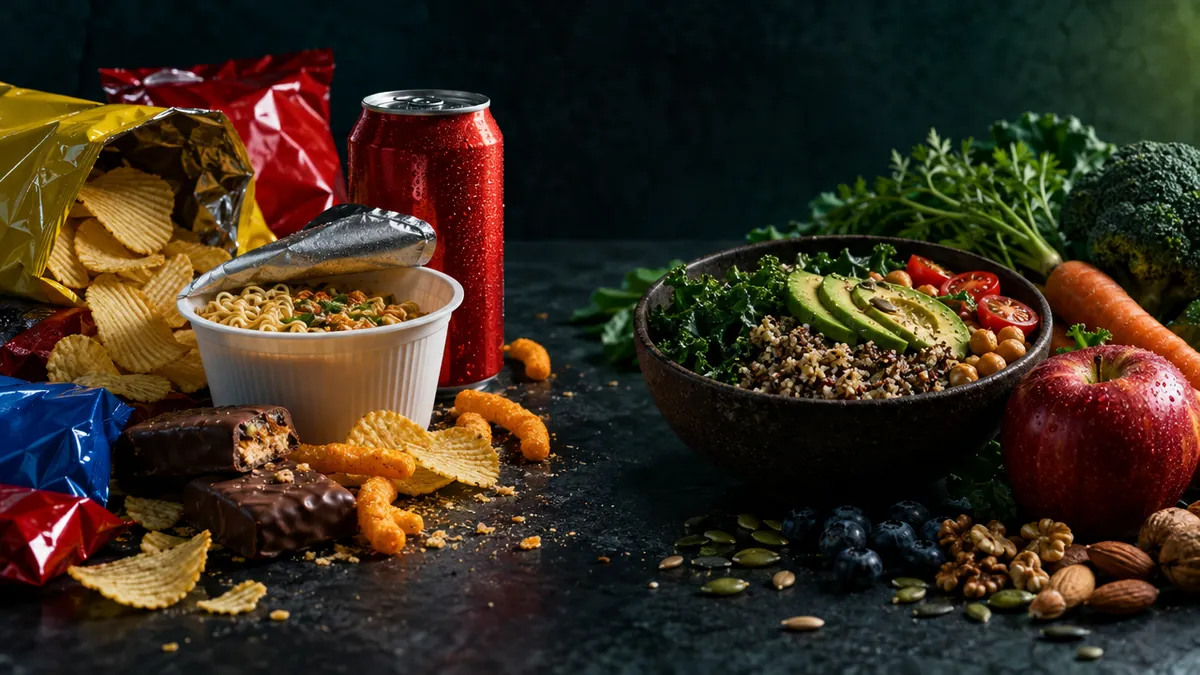
Ultra-processed foods: are they really harmful, and what does it mean day to day?
Ultra-processed foods (group 4 in the NOVA system) are industrial products with many additives, lots of fat, sugar or salt, and often little fibre: soft drinks, crisps, packaged pastries, instant meals, processed meats.
What does research show?
- According to a BMJ review, eating more ultra-processed food was linked to more negative health outcomes (such as cardiovascular disease, type 2 diabetes, early death). These are observational data and do not prove cause and effect.
- In a controlled inpatient trial (Hall et al.), participants eating an ultra-processed diet for two weeks ate about 500 kcal more a day and gained 0.9 kg on average, while they lost weight on the unprocessed diet.
Not all “processed” food is bad
NOVA looks at the degree of processing, not nutritional value. Plain yoghurt, tinned legumes, frozen vegetables, wholemeal bread or protein powder can be practical, useful foods. The aim is to build the base of your main meals on minimally processed foods.
How to cut down sensibly
- Swap soft drinks for water, sparkling water or unsweetened tea.
- For breakfast, oats, eggs or plain yoghurt instead of packaged cereal.
- Cook from ingredients, with meal prep at the weekend.
- Read the ingredients list: a long list with unfamiliar substances probably means ultra-processed.
- It need not be all or nothing: an 80/20 rule is already a big step forward.
Related: added sugar, the Mediterranean diet.
This article is general information, not medical or dietary advice.
Sources
- Hall KD et al. (2019): Ultra-processed diets cause excess calorie intake and weight gain: an inpatient randomized controlled trial of ad libitum food intake. Cell Metab 30(1):67–77
- Monteiro CA et al. (2019): Ultra-processed foods: what they are and how to identify them. Public Health Nutr 22(5):936–941
- Lane MM et al. (2024): Ultra-processed food exposure and adverse health outcomes: umbrella review of epidemiological meta-analyses. BMJ 384:e077310
Updated: November 2026
Read on

How much sugar is too much? Added sugar and sweeteners
According to the WHO, added sugar should be at most 10% of your daily energy. What does that mean in grams, and what about sweeteners?
Nutrition
The Mediterranean diet: what it means in practice
Vegetables, legumes, fish, olive oil: the principles of the Mediterranean diet, a sample day, and how to bring it into everyday life simply.
Nutrition
Fibre: why most diets fall short
EFSA considers 25 grams of fibre a day adequate. Where it can come from, how to increase it without bloating, and how to fit it into your meals.
Napra: training, meals and weight in one place
Follow your goals with the Napra app: a training log that knows your machines and a meal log.