

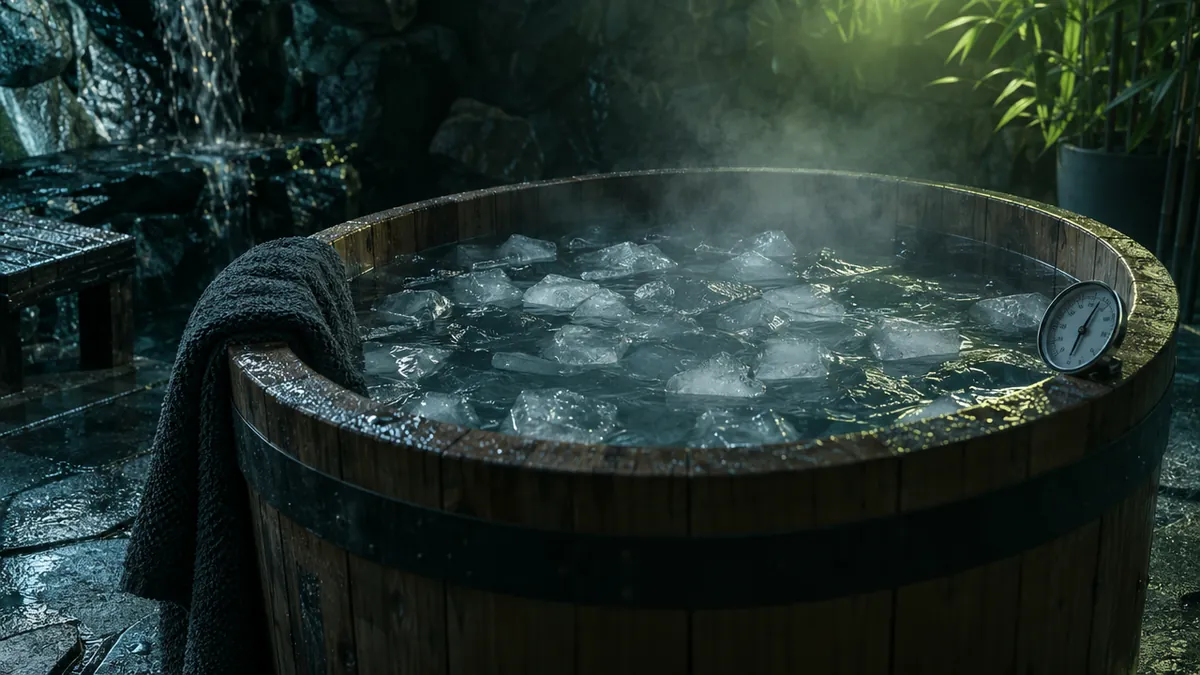
Cold plunge: what cold water does, and how to start safely
The cold plunge has become a trend in recent years: you get into cold water between 5 and 15 °C for a few minutes. Many call it “the strongest biohack”, so it is worth looking at what research supports, and what it does not.
What happens in the body?
Sudden cold triggers a physiological stress response: breathing and heart rate speed up, blood vessels in the skin narrow, and noradrenaline levels rise. This makes you feel more alert, and it explains why the plunge gives many people a “boost”. In a small Swedish–Danish study, the metabolism of men who regularly swam in winter rose more in the cold, but this came from a small sample without a controlled group.
Recovery and muscle building
According to a Cochrane review, cold water immersion can reduce muscle soreness after exercise compared with rest. However, in a controlled study, cold immersion used regularly after strength training led to less muscle growth and strength gain over 12 weeks than active recovery.
- If building muscle is your goal, do not plunge right after strength training. Leave at least a few hours, or do it on a rest day instead.
- In endurance competitions, or when you need to recover quickly (for example several matches in one day), it can be useful.
How to start safely
- Start with a cold shower: 30 seconds at the end, then gradually longer.
- For a plunge, 10–15 °C and 1–3 minutes is plenty to start. You do not need ice.
- Breathe slowly and in a controlled way. The “cold shock” breathing when you first get in is the most dangerous phase.
- Do not plunge alone, and in open water never after alcohol or when exhausted.
- Afterwards, get dressed and warm up gradually. Do not jump straight into a hot sauna or bath.
How this connects to our other article
You can find the effects of cold and heat (sauna) here: cold showers and sauna. You can read about recovery in general in the muscle soreness article.
This article is general information, not medical advice.
Sources
- Søberg S et al. (2021): Altered brown fat thermoregulation and enhanced cold-induced thermogenesis in young, healthy, winter-swimming men. Cell Rep Med 2(10):100408
- Roberts LA et al. (2015): Post-exercise cold water immersion attenuates acute anabolic signalling and long-term adaptations in muscle to strength training. J Physiol 593(18):4285–4301
- Bleakley C et al. (2012): Cold-water immersion (cryotherapy) for preventing and treating muscle soreness after exercise. Cochrane Database Syst Rev 2012(2):CD008262
- Tipton MJ et al. (2017): Cold water immersion: kill or cure? Exp Physiol 102(11):1335–1355
Updated: November 2026
Read on
Cold showers and sauna: what we know about their effects
Cold water immersion and sauna: when they help recovery, when they can hurt muscle building, and what to watch out for.
Training
Muscle soreness: what causes it, and what really helps?
Muscle soreness is normal, and it is not a measure of how effective your training was. What research shows about recovery methods.
Lifestyle
Stress and exercise: what can training do for tension?
How regular exercise relates to stress, mood and sleep, and how to use it as an everyday tool.
Napra: training, meals and weight in one place
Follow your goals with the Napra app: a training log that knows your machines and a meal log.